Trending...
- New Home of the Month: Spacious Luxury Meets Modern Design in The Bristol at Heritage at Manalapan
- Jeff Miller for Clark County Clerk: Campaign Signals Strong Early Voting Momentum in Las Vegas
- USA Med Bed Helping Home Care Patients with Refurbished Hill Rom Hospital Beds



Copperhill Technologies, a provider of embedded systems for LIN Bus automotive applications, offers a great selection of products for various embedded platforms, such as the Raspberry Pi, the Arduino-compatible Teensy, and breakout boards for generic embedded systems.
GREENFIELD, Mass. - nvtip -- LIN (Local Interconnect Network) is a serial network protocol used for communication between vehicle components. It is a single-wire, serial network protocol that supports communications up to 19.2 Kbit/s at a bus length of 40 meters (~120 feet). Copperhill Technologies offers a variety of embedded solutions for LIN Bus applications.
The Raspberry Pi Pico LIN Bus board supports the programming of automotive applications using MicroPython. The RPi Pico is a low-cost, high-performance microcontroller board with flexible digital interfaces. It features two ARM Cortex-M0+ cores that run up to 133MHz, 256KB RAM, 30 GPIO pins, and a wide range of interfacing options. These features are paired with 2MB of onboard QSPI Flash memory for code and data storage. In addition to powerful hardware resources, the Pico offers rich and complete software support and community resources. It comes with a complete Rasberry Pi official C/C++ SDK, Micropython SDK.
More on nvtip.com
This PiCAN FD board has a LIN Bus interface, and the Microchip MCP2518FD IC provides classic CAN and CAN FD. A dsPIC33 microcontroller provides the LIN Bus connection. Communication to the Pi is per UART on ttyS0 using ASCII text commands. A sample LIN-bus GUI app is available, written in Python3 and tkinter. The firmware is updatable using the Microchip UnifiedHost java app, which requires the Raspberry Pi to run in GUI mode. There is an easy-to-install SocketCAN driver, and programming is supported in C or Python. The 3A SMPS (Switch Mode Power Supply) module powers the PiCAN FD LIN-bus board and Raspberry Pi from 7 VDC to 24 VDC external supply.
The Teensy 4.0 with CAN FD and LIN Bus is a CAN FD breakout board for use with the Teensy 4.0 (included in the scope of delivery). It has an onboard 5 VDC regulator with reverse voltage protection and a CAN FD transceiver. The Microchip MCP2004A chip provides the LIN Bus connection. The Teensy is a complete USB-based microcontroller development system compatible with Arduino software and libraries. It comes with a minimal footprint and is capable of implementing many projects. All programming is accomplished via the onboard USB port.
More on nvtip.com
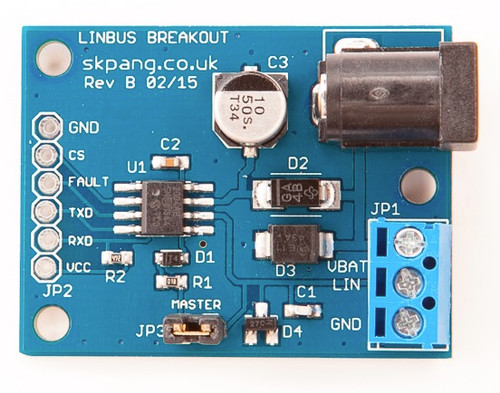
Furthermore, Copperhill Technologies offers a LIN Bus breakout board with a Microchip MCP2004A transceiver for all other embedded systems. The connection between the LIN bus breakout board and an embedded system, such as the Arduino, is a simple standard UART connection. The board complies with SAE J2602 and meets LIN Bus Specifications 1.3, 2.0, and 2.1. It can operate in Master or Slave mode through an onboard jumper.
The Raspberry Pi Pico LIN Bus board supports the programming of automotive applications using MicroPython. The RPi Pico is a low-cost, high-performance microcontroller board with flexible digital interfaces. It features two ARM Cortex-M0+ cores that run up to 133MHz, 256KB RAM, 30 GPIO pins, and a wide range of interfacing options. These features are paired with 2MB of onboard QSPI Flash memory for code and data storage. In addition to powerful hardware resources, the Pico offers rich and complete software support and community resources. It comes with a complete Rasberry Pi official C/C++ SDK, Micropython SDK.
More on nvtip.com
- Zenylitics Announces Leadership Transition to Continue Accelerated Growth
- Wellness Technology Distributor Helping People Set Up Wellness Center Businesses
- Christian Apocalyptic Thriller Explores Biblical Prophecy, Global Technology, & the Rise of the Ant
- Avery Burton Foundation Announces 2026 Student Scholarship Award Winners
- The Hidden Price Of Lost Property In UK Schools
This PiCAN FD board has a LIN Bus interface, and the Microchip MCP2518FD IC provides classic CAN and CAN FD. A dsPIC33 microcontroller provides the LIN Bus connection. Communication to the Pi is per UART on ttyS0 using ASCII text commands. A sample LIN-bus GUI app is available, written in Python3 and tkinter. The firmware is updatable using the Microchip UnifiedHost java app, which requires the Raspberry Pi to run in GUI mode. There is an easy-to-install SocketCAN driver, and programming is supported in C or Python. The 3A SMPS (Switch Mode Power Supply) module powers the PiCAN FD LIN-bus board and Raspberry Pi from 7 VDC to 24 VDC external supply.
The Teensy 4.0 with CAN FD and LIN Bus is a CAN FD breakout board for use with the Teensy 4.0 (included in the scope of delivery). It has an onboard 5 VDC regulator with reverse voltage protection and a CAN FD transceiver. The Microchip MCP2004A chip provides the LIN Bus connection. The Teensy is a complete USB-based microcontroller development system compatible with Arduino software and libraries. It comes with a minimal footprint and is capable of implementing many projects. All programming is accomplished via the onboard USB port.
More on nvtip.com
- Milton Collier, CEO & President of Freight Broker 911, Eliminates the #1 Barrier to Entry in Logistics: Announces 100% Free Freight Broker Training
- FDA-Cleared AI Neuropsychiatry Platform, Million-Dose Ketamine Manufacturing and Presidential Psychedelic Initiative Drive Growing Momentum for NRXP
- AI Velocity Trading Launches Institutional-Grade Algorithmic Engine for Retail Investors
- Speaker and Certified Coach Syrena N. Williams Debuts Powerful New Book on Healing, Identity, and Wholeness
- Kryptokasinot.io Raises Concerns Over Proposed Cryptocurrency Restrictions in Finland's Gambling Reform
Furthermore, Copperhill Technologies offers a LIN Bus breakout board with a Microchip MCP2004A transceiver for all other embedded systems. The connection between the LIN bus breakout board and an embedded system, such as the Arduino, is a simple standard UART connection. The board complies with SAE J2602 and meets LIN Bus Specifications 1.3, 2.0, and 2.1. It can operate in Master or Slave mode through an onboard jumper.
Source: Copperhill Technologies Corp.
0 Comments
Latest on nvtip.com
- Curious About Mensa? DFW Event Offers a 1-Day Immersion
- Buzzblender Announces Launch of Simple Hotel Mode for Android and Upcoming Video Wall Support for Samsung Professional Displays
- How Strategic WooCommerce Development and Digital Marketing Helped a Fashion Ecommerce Business Increase Revenue by 3X
- VIV Welcomes Residents to St. Petersburg's EDGE District
- Evocative Joins the Independent Data Centre Network (IDCN) as Primary USA Operator
- Medical Experts Highlight the Importance of Second Opinions in Death Investigations
- Joseph Nybyk aka Neibich of Gilbert, Arizona
- Don Barnhart Extends Hit Las Vegas Residency At Delirious Comedy Club Inside Silver Sevens
- Omnitronics Unveils 100% Software omniGateDMR and omniGateP25 RoIP Gateways
- KRE PRIME Launches Adaptive Convertible Jumpsuit
- Jeff Miller for Clark County Clerk: Campaign Signals Strong Early Voting Momentum in Las Vegas
- USA Med Bed Helping Home Care Patients with Refurbished Hill Rom Hospital Beds
- Sobreseimiento de Nicolás dos Santos y Jorge Méndez expone demandas millonarias a Paraguay y boicot a la Hidrovía
- CAPHRA warns Southeast Asia not to repeat Australia's nicotine policy failure
- Milo3D.ai Launches Free AI 3D Model Generator That Turns Text and Images Into Game-Ready 3D Assets in Seconds
- UK Financial Ltd Executes 100% Success Rate on All ERC-3643 Transfers to Coin Holders of MayaCat Regulated Security Token and Maya Preferred PRA
- Blank Space: The Unofficial Taylor Swift Tribute Brings Eras Tour Magic To Cities Across America
- Love Must Be the Guide: Live Good Shares a Message of Humanity, Compassion and Hope
- D.R. Crotzer Announces A New Science Fiction Book Series Exploring Life Energy, Dreams, and the Mystery of Existence
- Color Card Administrator Highlights Growing Enterprise Demand for Operational Infrastructure in Business Card Identity Governance