Trending...
- Ritz-Carlton Residences Houston Generates Strong Early New Construction Sales at 2120 Post Oak Blvd
- The Refugee Archive Launches Campaign to Preserve 21 Female-Headed Household Oral Histories in Rebel-Controlled Goma
- VegasAilure From AI Hotel Recommendation to the Traveler Experience Solution

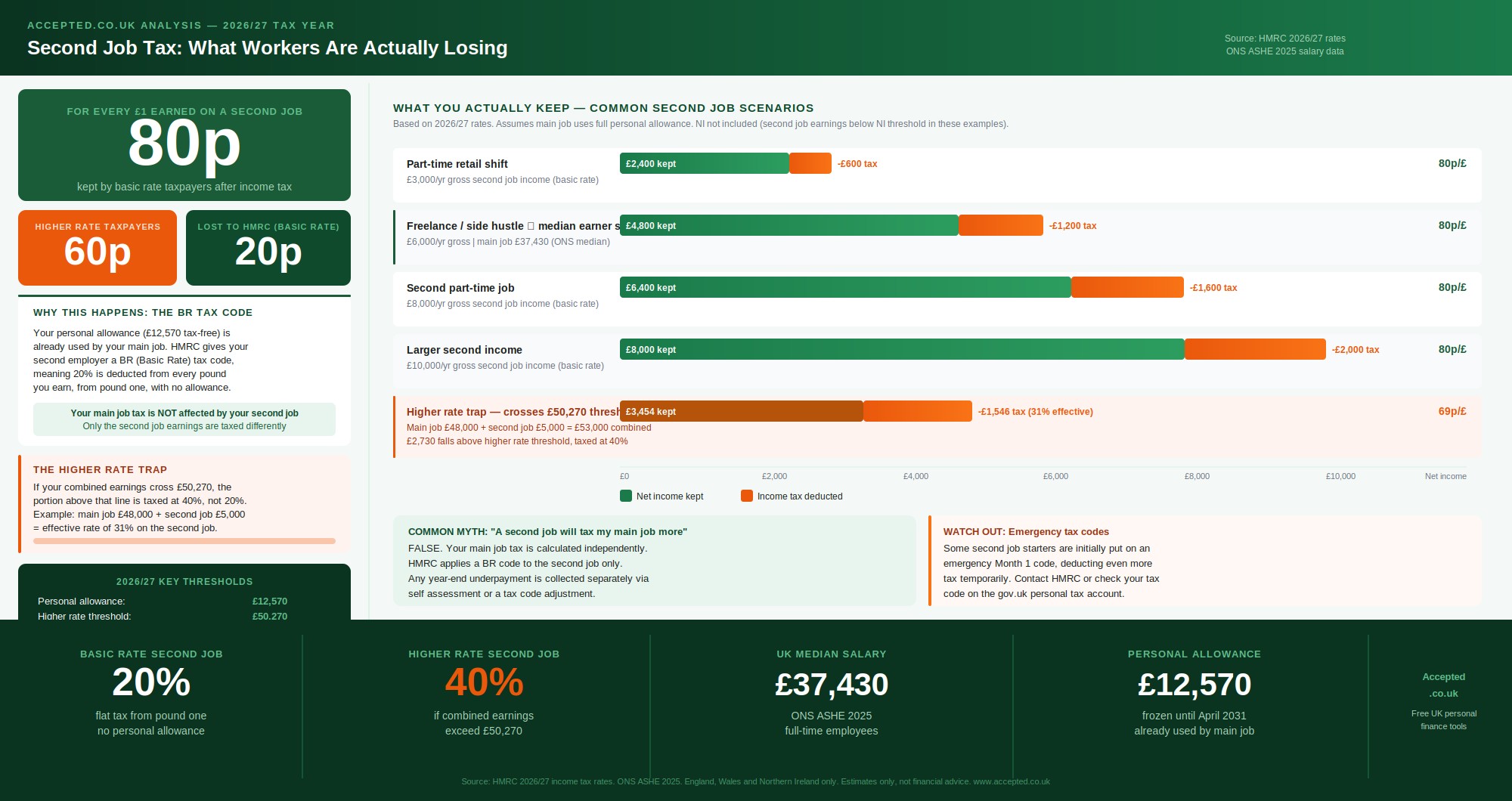

Research by free financial tools site Accepted.co.uk has calculated what workers with a second job actually take home after tax, revealing that the typical second-job earner loses 20p in every pound to HMRC before they see a penny, with those pushed into the higher rate band losing up to 40p in every pound.
BRAMHALL, STOCKPORT, U.K. - nvtip -- Analysis by Accepted.co.uk, using 2026/27 income tax and National Insurance rates, has modelled the real take-home pay from a second job across a range of common earnings scenarios, from part-time retail shifts to freelance side hustles.
The research finds that a worker on the UK's median full-time salary of £37,430 who takes on a second job earning £6,000 a year, the equivalent of roughly two shifts a week in retail or hospitality, will lose £1,200 of that to income tax before they receive a penny. That leaves them with £4,800, or 80p for every pound earned. The position worsens for anyone whose combined earnings from both jobs push them above the £50,270 higher rate threshold. At that point, every additional pound earned on the second job is taxed at 40 per cent rather than 20 per cent, leaving higher rate workers with just 60p in the pound.
The confusion stems from how HMRC codes second jobs. Because the personal allowance, the £12,570 of earnings on which no income tax is paid, is already allocated to the main job, a second employer is instructed to apply a BR tax code. BR stands for basic rate and means a flat 20 per cent is deducted from every pound of second job income from the very first pound, with no tax-free allowance applied. Workers who are initially put on an emergency tax code can find themselves temporarily losing even more until the code is corrected.
More on nvtip.com
David Morris, Personal Finance Editor at Accepted.co.uk, commented: "A lot of people take on a second job expecting to keep most of what they earn, then get a nasty surprise when they see their first payslip. Twenty per cent off the top from pound one is a real shock when you are used to a personal allowance absorbing the first £12,570. The BR code is correct, but it catches people off guard every time."
The analysis also highlights a threshold trap affecting workers on higher salaries. Someone earning £48,000 in their main job who takes on a second role paying £5,000 will see their combined income reach £53,000, pulling £2,730 above the higher rate threshold of £50,270. The portion of second job income that crosses that line is taxed at 40 per cent rather than 20 per cent, meaning the effective tax rate across the full second job is around 31 per cent rather than the flat 20 per cent many would assume.
The research comes as more British workers than at any point in the past decade are taking on additional employment to manage rising living costs. HMRC data shows second job registrations have increased significantly since 2022, with an estimated 1.2 million workers now holding more than one employment simultaneously.
One common misconception the analysis addresses is the fear that taking a second job will increase the tax paid on the main job. This does not happen. Income tax is assessed across all income at the end of the tax year, but the main job itself is not retrospectively taxed more heavily because of second job earnings. Only the second job income is affected by the loss of the personal allowance.
More on nvtip.com
Data source and methodology: All tax calculations are based on confirmed 2026/27 income tax rates and thresholds for England, Wales and Northern Ireland. Personal allowance £12,570, basic rate 20 per cent on earnings from £12,571 to £50,270, higher rate 40 per cent above £50,270. Employee National Insurance: 8 per cent on earnings between £12,570 and £50,270, 2 per cent above. National Insurance is assessed per employment and does not accumulate across jobs in the same way as income tax. UK median full-time salary figure (£37,430) is sourced from the ONS Annual Survey of Hours and Earnings (ASHE) 2025, published November 2025. Scotland operates separate income tax bands and rates; figures in this release apply to England, Wales and Northern Ireland only.
Scope: Calculations assume no pension contributions, student loan deductions, benefits in kind, or other adjustments to taxable income. Results are estimates and individual circumstances will vary.
About: Accepted.co.uk is a free UK personal finance information and tools site offering 24 calculators and 40+ editorial guides across tax, mortgages, credit, savings, and business finance. The site carries no paywalls, advertising, or sponsored content. Readers can calculate their own second job take-home pay using the free Two Jobs Tax Calculator at
Media contact: David Morris, dave@accepted.co.uk
Disclaimer: The figures in this release are estimates based on publicly available tax rates and average earnings data. They do not constitute financial or tax advice. Individual circumstances vary and readers should consult a qualified adviser or use HMRC's own tools before making decisions.
The research finds that a worker on the UK's median full-time salary of £37,430 who takes on a second job earning £6,000 a year, the equivalent of roughly two shifts a week in retail or hospitality, will lose £1,200 of that to income tax before they receive a penny. That leaves them with £4,800, or 80p for every pound earned. The position worsens for anyone whose combined earnings from both jobs push them above the £50,270 higher rate threshold. At that point, every additional pound earned on the second job is taxed at 40 per cent rather than 20 per cent, leaving higher rate workers with just 60p in the pound.
The confusion stems from how HMRC codes second jobs. Because the personal allowance, the £12,570 of earnings on which no income tax is paid, is already allocated to the main job, a second employer is instructed to apply a BR tax code. BR stands for basic rate and means a flat 20 per cent is deducted from every pound of second job income from the very first pound, with no tax-free allowance applied. Workers who are initially put on an emergency tax code can find themselves temporarily losing even more until the code is corrected.
More on nvtip.com
- Mt. Rose Church Announces New Book of Revelation Bible Study in Reno
- NaturismRE expands international research programme with Health & Wellbeing Survey
- L2 Aviation and Gotonomi Extend UAV Connectivity Beyond Cellular Reach
- Re:InvestorHub Launches the First AI-Powered Operating System Built for Real Estate Investors
- Nadi Plumbing Leads Charlotte in Private Fire Hydrant Services, Eyes Regional Expansion
David Morris, Personal Finance Editor at Accepted.co.uk, commented: "A lot of people take on a second job expecting to keep most of what they earn, then get a nasty surprise when they see their first payslip. Twenty per cent off the top from pound one is a real shock when you are used to a personal allowance absorbing the first £12,570. The BR code is correct, but it catches people off guard every time."
The analysis also highlights a threshold trap affecting workers on higher salaries. Someone earning £48,000 in their main job who takes on a second role paying £5,000 will see their combined income reach £53,000, pulling £2,730 above the higher rate threshold of £50,270. The portion of second job income that crosses that line is taxed at 40 per cent rather than 20 per cent, meaning the effective tax rate across the full second job is around 31 per cent rather than the flat 20 per cent many would assume.
The research comes as more British workers than at any point in the past decade are taking on additional employment to manage rising living costs. HMRC data shows second job registrations have increased significantly since 2022, with an estimated 1.2 million workers now holding more than one employment simultaneously.
One common misconception the analysis addresses is the fear that taking a second job will increase the tax paid on the main job. This does not happen. Income tax is assessed across all income at the end of the tax year, but the main job itself is not retrospectively taxed more heavily because of second job earnings. Only the second job income is affected by the loss of the personal allowance.
More on nvtip.com
- Toroidal Information Execution Engine, Delivering a 2,000% Throughput Gain to Combat AI Data Centers
- FindCostSeg Launches Nationwide Directory for Cost Segregation Providers
- Master Of Science, Juggernaut Of The Screen: Landon Brittain Emerges As Hollywood's Most Unlikely Leading Man
- Black Dog Venture Partners and VC Fast Pitch to Host "San Francisco Investors and Innovators" Networking Event
- Don Barnhart Marks 10 Years of Las Vegas Comedy With Delirious Comedy Club Anniversary Celebration
Data source and methodology: All tax calculations are based on confirmed 2026/27 income tax rates and thresholds for England, Wales and Northern Ireland. Personal allowance £12,570, basic rate 20 per cent on earnings from £12,571 to £50,270, higher rate 40 per cent above £50,270. Employee National Insurance: 8 per cent on earnings between £12,570 and £50,270, 2 per cent above. National Insurance is assessed per employment and does not accumulate across jobs in the same way as income tax. UK median full-time salary figure (£37,430) is sourced from the ONS Annual Survey of Hours and Earnings (ASHE) 2025, published November 2025. Scotland operates separate income tax bands and rates; figures in this release apply to England, Wales and Northern Ireland only.
Scope: Calculations assume no pension contributions, student loan deductions, benefits in kind, or other adjustments to taxable income. Results are estimates and individual circumstances will vary.
About: Accepted.co.uk is a free UK personal finance information and tools site offering 24 calculators and 40+ editorial guides across tax, mortgages, credit, savings, and business finance. The site carries no paywalls, advertising, or sponsored content. Readers can calculate their own second job take-home pay using the free Two Jobs Tax Calculator at
Media contact: David Morris, dave@accepted.co.uk
Disclaimer: The figures in this release are estimates based on publicly available tax rates and average earnings data. They do not constitute financial or tax advice. Individual circumstances vary and readers should consult a qualified adviser or use HMRC's own tools before making decisions.
Source: Accepted.co.uk
0 Comments
Latest on nvtip.com
- Paula Josephine Sadler Releases "Imagine" on 24th Anniversary of Sobriety
- GoVia Alliance Group Formalizes Interim Leadership as Distribution Centers Head Into Peak Season
- Ritz-Carlton Residences Houston Generates Strong Early New Construction Sales at 2120 Post Oak Blvd
- No Sugar Baker Continues National Growth with Seattle Market Expansion Across Washington, Idaho, and Alaska
- VegasAilure From AI Hotel Recommendation to the Traveler Experience Solution
- The Refugee Archive Launches Campaign to Preserve 21 Female-Headed Household Oral Histories in Rebel-Controlled Goma
- Space Ambitions Expanding as New Testing Builds on NASA Results and Targets MEO, GEO and Next-Generation Orbital Markets: Ascent Solar Technologies
- FDA Path Clears, Manufacturing Ramps Up + $22.3 Million Strengthens the Balance Sheet; Inflection Point for NRx Pharmaceuticals (N A S D A Q: NRXP)
- Buy Retatrutide Research Peptide: Why Reta Is Getting So Much Attention
- Phinge Offers to Join Child Safety Advocacy Groups in Congress to Combat Online Exploitation: Educate Lawmakers on Netverse Zero-trust App-less Tech
- San Diego Attorney Anthony Z. Vargas Narrows Practice to Employment Law, Representing Employees Only
- Solid Earth Introduces RealtyID, a Universal Identity Spine for the Real Estate Industry
- BlazeHive's AI SEO Agent Outranks Human Writers on 500+ Google Top-3 Results in 5 Months, on Autopilot
- Phinge Exposes Massive AI Security Risks, Claiming Its Patented Hardware-Verified Architecture Is The Only Safeguard Against Surveillance Capitalism
- Phinge & CEO Robert DeMaio Publicly Declare Cash Settlements or Judgments Alone Cannot & Will Not Remedy the Deep Public Harm of Infringing Its IP
- Dana Flanagan Expands the Authority Architect, Bringing a Nontraditional Approach to Executive Authority, Strategic Access and Business Growth
- Phinge's Netverse: Reclaiming the Digital Frontier For Everyone Through CEO Robert DeMaio's Vision of a True App-less, User Data Sovereign World
- DuraFast Label Company Launches Seiko SLP850 2" Thermal Printer with Free Label Promotion
- Scientific Figure Releases Free Layout Template Libraries for Graphical Abstracts and Research Posters
- Permian Museum announces the addition of an Ancient Alien Artifacts photo gallery