Trending...
- Delirious Comedy Club Celebrates Five Best Of Las Vegas Nominations And 1 Year At Silver Sevens
- NVision Optix Highlights Personalized Dry Eye Care During Dry Eye Awareness Month
- Independent Colbert Packaging Thrives Amid Industrywide Consolidation
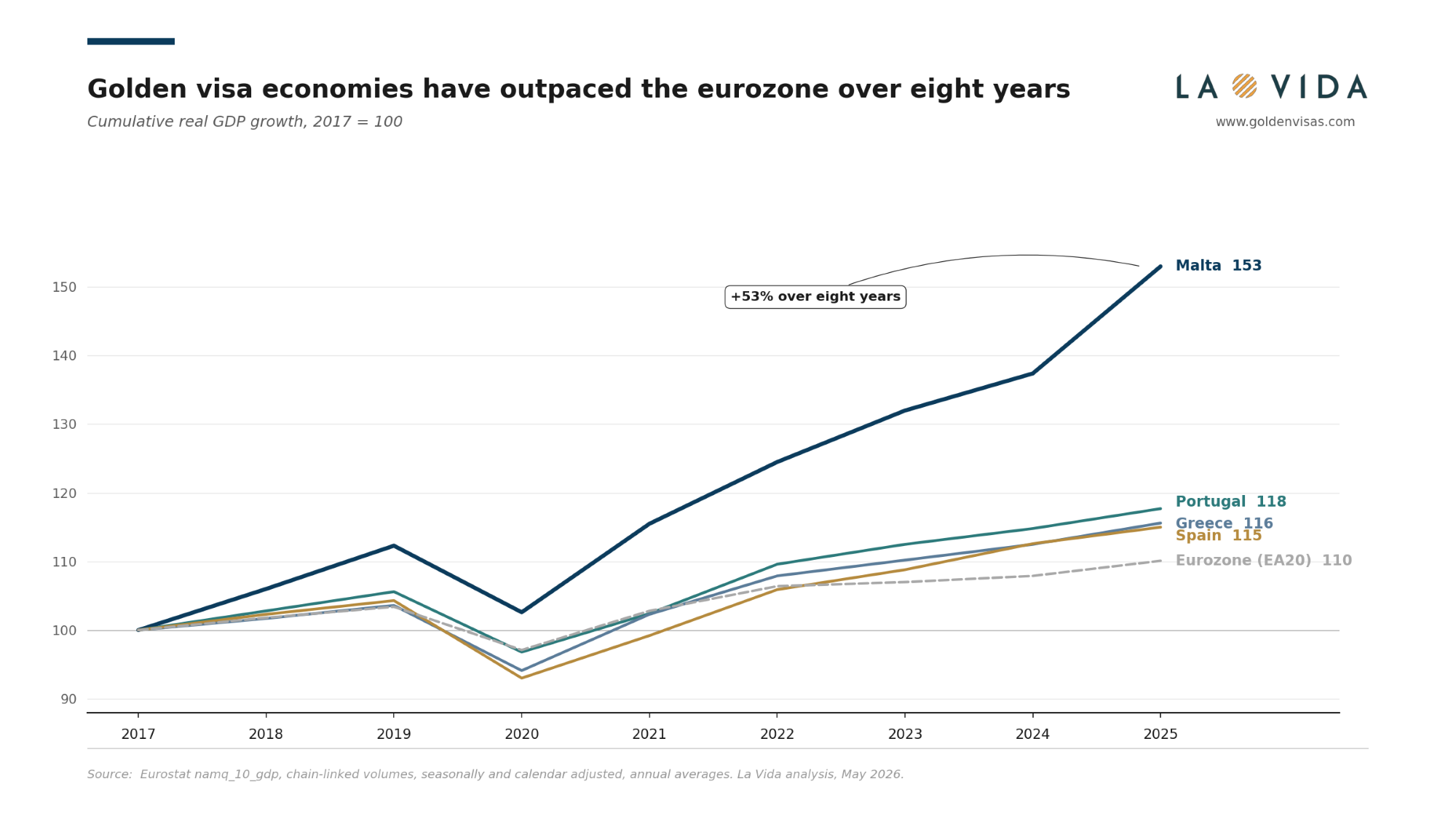

Real GDP in Malta, Portugal, Greece and Spain grew faster than the eurozone average from 2017 to 2025, according to research published today by investment migration firm La Vida. The four economies — all of which operated investment migration programmes throughout the period — outperformed the bloc on both aggregate and per-capita measures.
UXBRIDGE, U.K. - nvtip -- LONDON — The four European countries that ran continuous investment migration programmes from 2017 to 2025 each grew faster in real GDP terms than the eurozone average, new analysis from UK-based investment migration advisory firm La Vida has found.
Drawing on official Eurostat national accounts data, the research shows Malta's economy grew 53% in real terms over the eight years, Portugal by 17.7%, Greece by 15.6% and Spain by 15.0%. The eurozone aggregate over the same period grew 10.1%.
The pattern holds when adjusted for population. On a real GDP-per-capita basis, Malta grew by 22.4%, Greece by 19.3%, Portugal by 12.9% and Spain by 8.8%, against a eurozone figure of 7.7%.
More on nvtip.com
Direct investment associated with the programmes themselves is too small to account for the difference. La Vida estimates the qualifying investment generated by the four programmes sits in the range of 0.025% to 0.25% of national GDP per year — an order of magnitude or more below the size of the growth gaps observed.
Paul Williams, CEO and Founder of La Vida, said:
"European economies are struggling for growth while government debt continues to climb. Governments and the EU need to take a closer look at the role residency and citizenship by investment can play in attracting productive wealth into their economies. Our analysis doesn't prove the programmes drove the growth gap. But the direction of the data is hard to ignore, and the contribution of wealthy migrants extends well beyond their initial qualifying investment — through businesses they start, taxes they pay over time, and capital they go on to deploy."
La Vida research identifies three non-exclusive readings of the data. Direct investment under the programmes contributed to growth through real estate, construction, government revenue and associated multiplier effects, but at a modest scale. A second channel runs through the entrepreneurial behaviour of programme beneficiaries themselves — investment beyond the qualifying minimum, business formation, employment creation and tax contributions over time. A third reflects shared characteristics across the four economies that drove growth independently of investment migration policy, including post-pandemic tourism recoveries, EU recovery fund allocations, services exports and recovery from the post-2012 sovereign debt crisis.
More on nvtip.com
The European investment migration landscape has shifted markedly since the period analysed. Spain closed its programme in April 2025. Portugal removed real estate as a qualifying route in October 2023 shifting to Private Equity investment. Malta's citizenship-by-investment route was struck down by the European Court of Justice in April 2025, though its residence programme continues. Greece's programme remains open.
"The next eight years will not look like the last," Williams added. "Several of these programmes have been reformed or closed. But the debate about whether the underlying policy works — attracting wealth in exchange for residency or citizenship — is more relevant than ever. The UK has signalled interest in reintroducing an investor route. The US has its Trump Card proposal. Argentina has tendered for a new programme. Governments are looking at this again because debt levels and demographic pressures demand it."
The full analysis of GDP growth in golden visa countries, including methodology and source data, is available at www.goldenvisas.com/gdp-growth-in-eu-and-golden-visa-economies.
Drawing on official Eurostat national accounts data, the research shows Malta's economy grew 53% in real terms over the eight years, Portugal by 17.7%, Greece by 15.6% and Spain by 15.0%. The eurozone aggregate over the same period grew 10.1%.
The pattern holds when adjusted for population. On a real GDP-per-capita basis, Malta grew by 22.4%, Greece by 19.3%, Portugal by 12.9% and Spain by 8.8%, against a eurozone figure of 7.7%.
More on nvtip.com
- DOULA CO-OP of Nevada Names Christine Ruggiero as End-of-Life Director
- Pete Verbica: America Needs Statesmanship and Common Sense — Not a Cult of Personality
- Delirious Comedy Club Celebrates 1-Year Anniversary at Silver Sevens With Permanent $19.95 Tickets
- Heidi G. Villari of The Villari Firm, PLLC Recognized in The Best Lawyers in America 2027 for Construction Law and Personal Injury Litigation
- When the Coroner's Report Isn't Enough: Colorado Families Turn to Private Autopsy for Closure
Direct investment associated with the programmes themselves is too small to account for the difference. La Vida estimates the qualifying investment generated by the four programmes sits in the range of 0.025% to 0.25% of national GDP per year — an order of magnitude or more below the size of the growth gaps observed.
Paul Williams, CEO and Founder of La Vida, said:
"European economies are struggling for growth while government debt continues to climb. Governments and the EU need to take a closer look at the role residency and citizenship by investment can play in attracting productive wealth into their economies. Our analysis doesn't prove the programmes drove the growth gap. But the direction of the data is hard to ignore, and the contribution of wealthy migrants extends well beyond their initial qualifying investment — through businesses they start, taxes they pay over time, and capital they go on to deploy."
La Vida research identifies three non-exclusive readings of the data. Direct investment under the programmes contributed to growth through real estate, construction, government revenue and associated multiplier effects, but at a modest scale. A second channel runs through the entrepreneurial behaviour of programme beneficiaries themselves — investment beyond the qualifying minimum, business formation, employment creation and tax contributions over time. A third reflects shared characteristics across the four economies that drove growth independently of investment migration policy, including post-pandemic tourism recoveries, EU recovery fund allocations, services exports and recovery from the post-2012 sovereign debt crisis.
More on nvtip.com
- Nearly One-Third of CRE Asset Managers Make Major Capital Decisions on Gut Instinct, New Survey Finds
- RemoteBridge Names Dr. John N. Just, Ed.D. Chief Executive Officer
- Project CIVICA Report Finds 10,680 Non-Citizen Indicators on New York Voter Rolls — Including 88 Records with Recent Voting History
- New Analysis Details Three Converging Forces in AI and Workforce Policy Behind a $37 Billion GDP Reduction
- Revenue Optics Launches Pricing and Revenue Growth Management Practice, Names Shafohi Alamgir Vice President
The European investment migration landscape has shifted markedly since the period analysed. Spain closed its programme in April 2025. Portugal removed real estate as a qualifying route in October 2023 shifting to Private Equity investment. Malta's citizenship-by-investment route was struck down by the European Court of Justice in April 2025, though its residence programme continues. Greece's programme remains open.
"The next eight years will not look like the last," Williams added. "Several of these programmes have been reformed or closed. But the debate about whether the underlying policy works — attracting wealth in exchange for residency or citizenship — is more relevant than ever. The UK has signalled interest in reintroducing an investor route. The US has its Trump Card proposal. Argentina has tendered for a new programme. Governments are looking at this again because debt levels and demographic pressures demand it."
The full analysis of GDP growth in golden visa countries, including methodology and source data, is available at www.goldenvisas.com/gdp-growth-in-eu-and-golden-visa-economies.
Source: La Vida Europe Ltd
Filed Under: Real Estate
0 Comments
Latest on nvtip.com
- Food Journal Magazine Focuses Its Los Angeles Dining Coverage Across Three Editorial Verticals
- Where Do Missouri Plane Crashes Really Happen? Not Where You'd Think
- LCC Asia Pacific Sponsors CubeSatPlus 2026 at UNSW Sydney
- Real Estate Syndication Attorney Tilden Moschetti Releases The Real Estate Private Equity Blueprint
- 5X Gross Margin Improvement to Beat EPS Consensus; $54.6 Million 10-Year Contract Award Puts Cybersecurity Leader on Path to a $30 Million Run Rate
- Independent Colbert Packaging Thrives Amid Industrywide Consolidation
- NVision Optix Highlights Personalized Dry Eye Care During Dry Eye Awareness Month
- Free Commercial Glass Estimating and Code Compliance Tools Launched by Landmark Construction - The Leading Glass Company in Los Angeles
- Delirious Comedy Club Celebrates Five Best Of Las Vegas Nominations And 1 Year At Silver Sevens
- Tallahassee Million-Dollar Home Sales Rise in 2026 as Median Selling Time More Than Doubles
- HOLOVOX Founder Robert Scott Took the Stage at Ai4 2026, North America's Largest AI Event
- Slotozilla Reports Strong Growth in Q2 2026
- Flexible Plan Investments Names Carl Resnick President
- Paula Josephine Sadler Releases "Imagine" on 24th Anniversary of Sobriety
- GoVia Alliance Group Formalizes Interim Leadership as Distribution Centers Head Into Peak Season
- Ritz-Carlton Residences Houston Generates Strong Early New Construction Sales at 2120 Post Oak Blvd
- No Sugar Baker Continues National Growth with Seattle Market Expansion Across Washington, Idaho, and Alaska
- VegasAilure From AI Hotel Recommendation to the Traveler Experience Solution
- The Refugee Archive Launches Campaign to Preserve 21 Female-Headed Household Oral Histories in Rebel-Controlled Goma
- Space Ambitions Expanding as New Testing Builds on NASA Results and Targets MEO, GEO and Next-Generation Orbital Markets: Ascent Solar Technologies